Why Reliable Power Infrastructure Is the Foundation of Modern Data Centers
Introduction:
In today’s digital economy, data centers have become some of the most critical facilities in the world. From cloud computing and artificial intelligence to financial transactions, healthcare systems, telecommunications, and e-commerce platforms, nearly every modern service relies on uninterrupted access to data.
The success of a data center depends on one essential factor above all others: reliable electrical power.
A momentary power interruption can result in service outages, financial losses, operational disruptions, reputational damage, and even regulatory consequences. As demand for digital services continues to grow, organizations are investing heavily in resilient power infrastructure that ensures maximum uptime and operational continuity.
Designing and operating a data center is far more complex than simply supplying electricity to a building. It requires sophisticated engineering, redundancy planning, protection systems, monitoring technologies, and commissioning procedures that work together to create a highly reliable environment.
At GRIDCREED, we provide advanced engineering support for data center electrical infrastructure, helping organizations design, validate, and optimize mission-critical power systems that meet the highest standards of performance and reliability.
The Growing Importance of Data Centers:
The global digital transformation has accelerated significantly over the past decade.
Several trends continue driving unprecedented demand for data center capacity:
* Cloud computing services
* Artificial intelligence workloads
* Big data analytics
* Streaming platforms
* Digital banking
* Smart manufacturing
* Internet of Things (IoT) applications
* Edge computing networks
As organizations become increasingly dependent on digital services, the tolerance for downtime continues to decrease.
Even a brief outage can impact thousands or millions of users simultaneously.
This reality places enormous responsibility on data center electrical infrastructure.
Understanding Data Center Uptime Requirements:
Data centers are typically classified according to reliability and redundancy requirements.
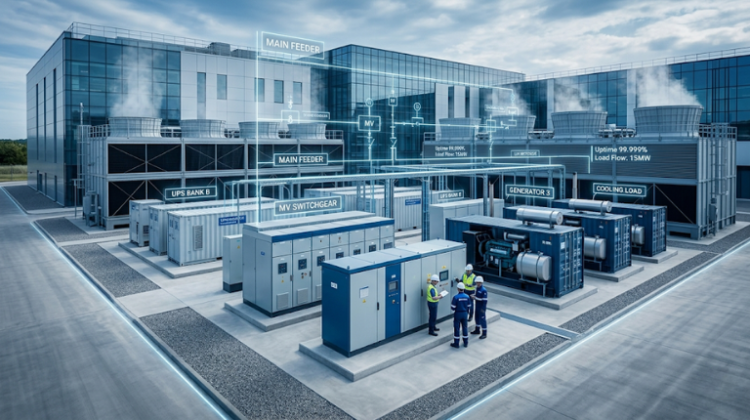
Operators often target uptime levels exceeding 99.99%, meaning systems must remain operational even during equipment failures, maintenance activities, or external utility disturbances.
Achieving these performance levels requires careful engineering and strategic planning.
Electrical systems must be designed to eliminate single points of failure while ensuring maintenance can be performed without disrupting operations.
This approach requires multiple layers of redundancy and backup capability.
Utility Power: The First Line of Defense:
Every data center begins with a utility grid connection.
While utility networks are generally reliable, they are not immune to disturbances caused by:
* Severe weather events
* Equipment failures
* Transmission faults
* Human error
* Natural disasters
Because utility interruptions can never be completely eliminated, data centers must incorporate additional protective measures to maintain continuous operation.
Understanding utility reliability, available capacity, fault levels, and future expansion plans is a critical part of data center design.
Engineering studies help evaluate these factors and ensure the facility is connected to the grid in the most effective manner possible.
Medium Voltage and Low Voltage Distribution Systems:
The electrical distribution network serves as the backbone of a data center.
Medium-voltage and low-voltage systems must be designed to provide:
* Reliable power delivery
* Operational flexibility
* Maintenance accessibility
* Fault isolation capability
* Future scalability
A well-designed distribution architecture minimizes operational risk while supporting future growth.
Engineers must carefully evaluate equipment ratings, load growth projections, protection requirements, and redundancy strategies during the design process.
The Critical Role of Uninterruptible Power Supply (UPS) Systems:
UPS systems are among the most important components within a data center.
Their primary function is to provide instantaneous backup power whenever utility disturbances occur.
UPS systems protect critical equipment from:
* Voltage sags
* Short interruptions
* Frequency deviations
* Power quality disturbances
* Complete utility outages
Because servers and networking equipment are highly sensitive to power disruptions, UPS systems provide the bridge between utility power loss and generator startup.
Proper sizing, redundancy planning, and battery management are essential for reliable UPS performance.
Backup Generators and Emergency Power Systems:
While UPS systems provide short-term power support, backup generators are responsible for sustaining operations during extended utility outages.
Modern data centers often utilize large diesel or gas-powered generators capable of supporting the facility’s full critical load.
Generator system design involves numerous considerations, including:
* Capacity requirements
* Fuel storage
* Startup performance
* Load acceptance capability
* Synchronization requirements
* Environmental compliance
Engineers must ensure generators can start rapidly and assume facility loads without compromising system stability.
Regular testing and maintenance are equally important to ensure readiness during emergencies.
ATS and STS Systems:
Automatic Transfer Switches (ATS) and Static Transfer Switches (STS) play a crucial role in maintaining continuity of service.
These systems automatically transfer loads between power sources whenever abnormal conditions occur.
Benefits include:
* Reduced downtime
* Faster fault response
* Increased operational resilience
* Improved system flexibility
Transfer systems must be carefully coordinated with UPS equipment, generators, and protection devices to ensure seamless operation.
Protection Coordination and Electrical Safety:
Data centers contain substantial electrical infrastructure that must be protected from fault conditions.
Protection systems are designed to:
* Detect faults rapidly
* Isolate affected equipment
* Prevent cascading failures
* Protect personnel
* Minimize downtime
Protection coordination studies ensure breakers and relays operate in the correct sequence during abnormal conditions.
A properly coordinated system prevents unnecessary outages while preserving critical services.
Safety remains equally important.
Arc flash studies help determine:
* Incident energy levels
* PPE requirements
* Safe working distances
* Hazard mitigation measures
These studies support regulatory compliance while protecting maintenance personnel and operators.
Power Quality Considerations:
Power quality directly affects the performance and reliability of data center equipment.
Common concerns include:
* Harmonic distortion
* Voltage fluctuations
* Transient events
* Frequency deviations
* Electrical noise
Poor power quality can lead to equipment malfunctions, reduced efficiency, and premature component failure.
Comprehensive power quality assessments help identify risks and implement corrective solutions before they impact operations.
Grounding and Earthing Systems:
Grounding systems are fundamental to electrical safety and equipment protection.
An effective grounding system:
* Protects personnel
* Supports fault current dissipation
* Reduces electrical noise
* Enhances equipment performance
* Supports lightning protection systems
Data centers often require highly specialized grounding designs due to the sensitivity of electronic equipment and the critical nature of operations.
Proper grounding contributes significantly to overall facility reliability.
Monitoring and Intelligent Infrastructure:
Modern data centers increasingly rely on real-time monitoring technologies.
Advanced monitoring systems provide visibility into:
* Power consumption
* Equipment status
* Environmental conditions
* Generator performance
* UPS health
* Electrical faults
Real-time data enables operators to identify issues before they become failures.
Predictive maintenance strategies supported by intelligent monitoring systems can significantly improve reliability while reducing operating costs.
Commissioning: Verifying System Readiness:
Even the most sophisticated design must be thoroughly tested before operation.
Commissioning is the process of verifying that all systems function as intended under real-world conditions.
Typical commissioning activities include:
* Equipment inspections
* Functional testing
* Integrated systems testing
* Generator load testing
* Transfer sequence validation
* Protection verification
A comprehensive commissioning program helps identify potential issues before they affect operations.
This process significantly reduces startup risks and improves long-term system performance.
Energy Efficiency and Sustainability:
Modern data center operators face increasing pressure to improve energy efficiency and reduce environmental impact.
Electrical infrastructure plays a major role in achieving these objectives.
Strategies include:
* Efficient power distribution architectures
* Advanced UPS technologies
* Intelligent cooling integration
* Renewable energy adoption
* Battery energy storage systems
* Energy monitoring platforms
Sustainable design not only reduces environmental impact but can also lower operational expenses throughout the facility lifecycle.
The Future of Data Center Power Infrastructure:
Several emerging trends are reshaping the industry.
These include:
* Artificial intelligence workloads
* High-density computing
* Modular data center designs
* Renewable energy integration
* Battery energy storage systems
* Smart grid connectivity
As power demands continue increasing, engineering excellence will become even more critical.
Future facilities must deliver higher performance, greater efficiency, and enhanced resilience while maintaining strict uptime requirements.
How GRIDCREED Supports Data Center Projects:
GRIDCREED provides specialized engineering support throughout the complete data center lifecycle.
Our services include:
* Electrical system design
* MV/LV distribution engineering
* UPS system evaluation
* Generator integration
* Protection coordination studies
* Arc flash analysis
* Grounding design
* Power quality assessments
* Monitoring system architecture
* Testing and commissioning support
* Operational readiness planning
Our engineering approach combines advanced technical analysis with practical field experience to ensure data centers operate safely, efficiently, and reliably.
Conclusion:
Reliable power infrastructure is the foundation upon which every successful data center is built.
From utility connections and UPS systems to generators, protection schemes, monitoring technologies, and commissioning procedures, every component plays a vital role in maintaining uninterrupted operations.
As digital services continue expanding across the globe, the demand for resilient and efficient data center infrastructure will only increase.
Organizations that invest in proper engineering, advanced analysis, and operational readiness position themselves to achieve superior reliability, reduced risk, and long-term success.
At GRIDCREED, we help clients design and deliver mission-critical electrical infrastructure capable of supporting the digital economy today and into the future.